
Pathways That Take Us Somewhere
Based on "Engaged Curiosity" (2025 Jack Ricchiuto, Nuance Works)

Whether groups are flourishing, struggling, or in crisis, people seek new ways of moving forward. They move forward when they have viable pathways. Viable means self-organized, responsive, and productive.
We teach groups how to co-construct viable pathways forward using a uniquely question-based framework, the Pathway Conversations™. People co-create viable pathways forward through four conversations that engage everyone's essential gifts of knowing, imagining, wondering, and doing. We engage these gifts through Learning, Assumptions, Questions, and Actions conversations. Without futile discussion, divisive voting, or top-down rules, people share responsibility for what they care about.
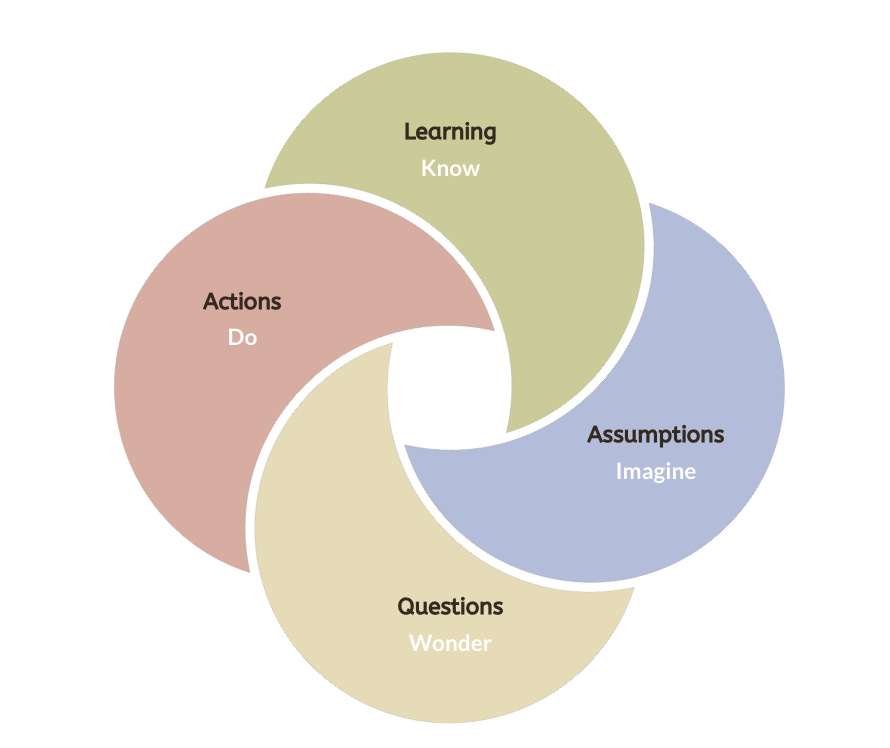
In the Learning conversation, people engage their gifts of knowing. They share what they know for sure relative to what they care about. In the Assumptions conversation, people engage their gifts of imagining. They share their hopes, concerns, and expectations. In the Questions conversation, people engage their gifts of wonder. They turn all of their assumptions into questions. In the Actions conversation, people engage their gifts of doing. They answer their most important questions by finding something out or trying something out.
People co-create unpredictable commonalities. They build the future they want to see, one right question at a time. They learn their way into new, unplanned possibilities.
While the four conversations of the framework get people somewhere, four conversations get and keep them stuck: blame, coercion, deficiency, and discussion conversations.
In a blame conversation, people talk about who is responsible for their dilemma. In a coercion conversation, people try to get others agreeing with them. In a deficiency conversation, people talk about what they're lacking. In a discussion conversation, people talk about their instant answers to any questions that come up. These conversations prevent new pathways because they explicitly deny everyone’s gifts of knowing, imagining, wondering, and doing.
Interestingly, each can be turned into a productive conversation by posting everything with assumptions and turning all into questions. They shift from being obstacles to opportunities.
The deceptively simple architecture of Pathway conversations works because the performance of groups is shaped by the quality of their conversations.
The essential difference between high-cohesion, high-performance groups and low-cohesion, low-performance groups is the structure of their conversations.
The power of the framework is grounded in its being question-based. New questions are intrinsically motivating and engaging. They challenge self-limiting, unquestioned assumptions. They catalyze new connections, opportunities, and possibilities. They make planning, especially in uncertainty, realistic because they foster quick feedback loops. With new questions, groups flourish in abundant uncertainties, perspectives, and constraints.
In work sessions, people work in small groups, co-creating the pathways that lead them somewhere new. No special training, leadership, or resources are required. People do what they can with what they have. It always works because each pathway engages everyone's essential gifts. In learning by doing, it takes groups about 90 minutes to learn how to build their pathways forward by doing and delivering.
Without explicitly trying to build "cultures" of trust, engagement, or safety, people intrinsically experience each as the framework builds layer upon layer of group cohesion. The stronger the group's cohesion, the more potential it has to do together what no one can do alone.
We’ve seen this in action with groups in organizations and communities worldwide since 1996 when the first iteration of the framework was developed.
What could your group do if they learned how to build pathways that take them somewhere?
For more about the Framework visit ThirdFloorDesign.org